highland park NEIGHBORS MAGAZINE COVER STORY FEATURING NICOLAS DeGRAZIA & THE BITTER JESTER MUSIC FEST 20th ANNIVERSARY
Check out what the HP Neighbors Mag has to say about the Bitter Jester Music Festival and its founder, Nicolas DeGrazia!
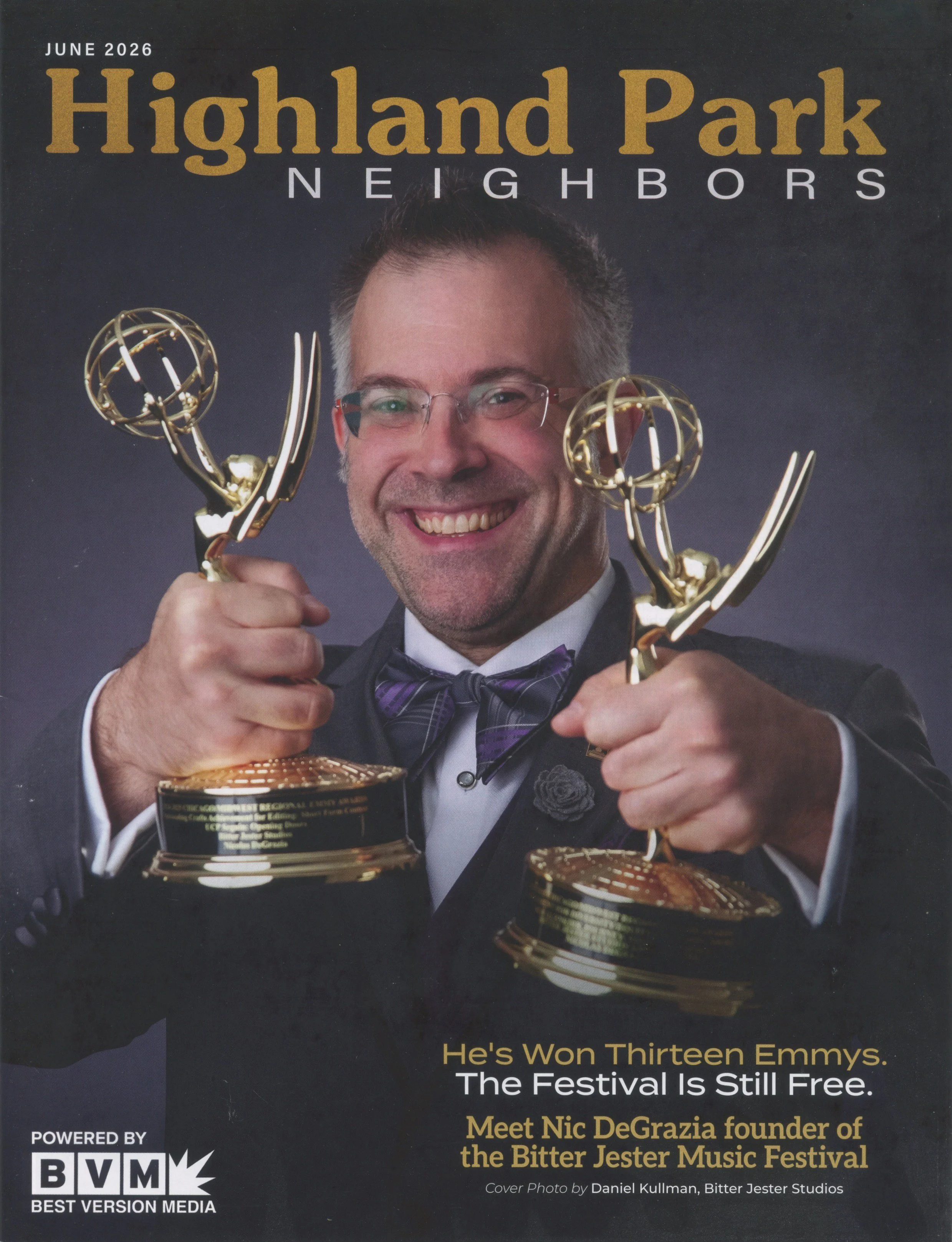
Highland Park Neighbors Magazine
“TWENTY SUMMERS”
Meet Nic DeGrazia, Founder of the Bitter Jester Music Festival
Feature Story: June, 2026
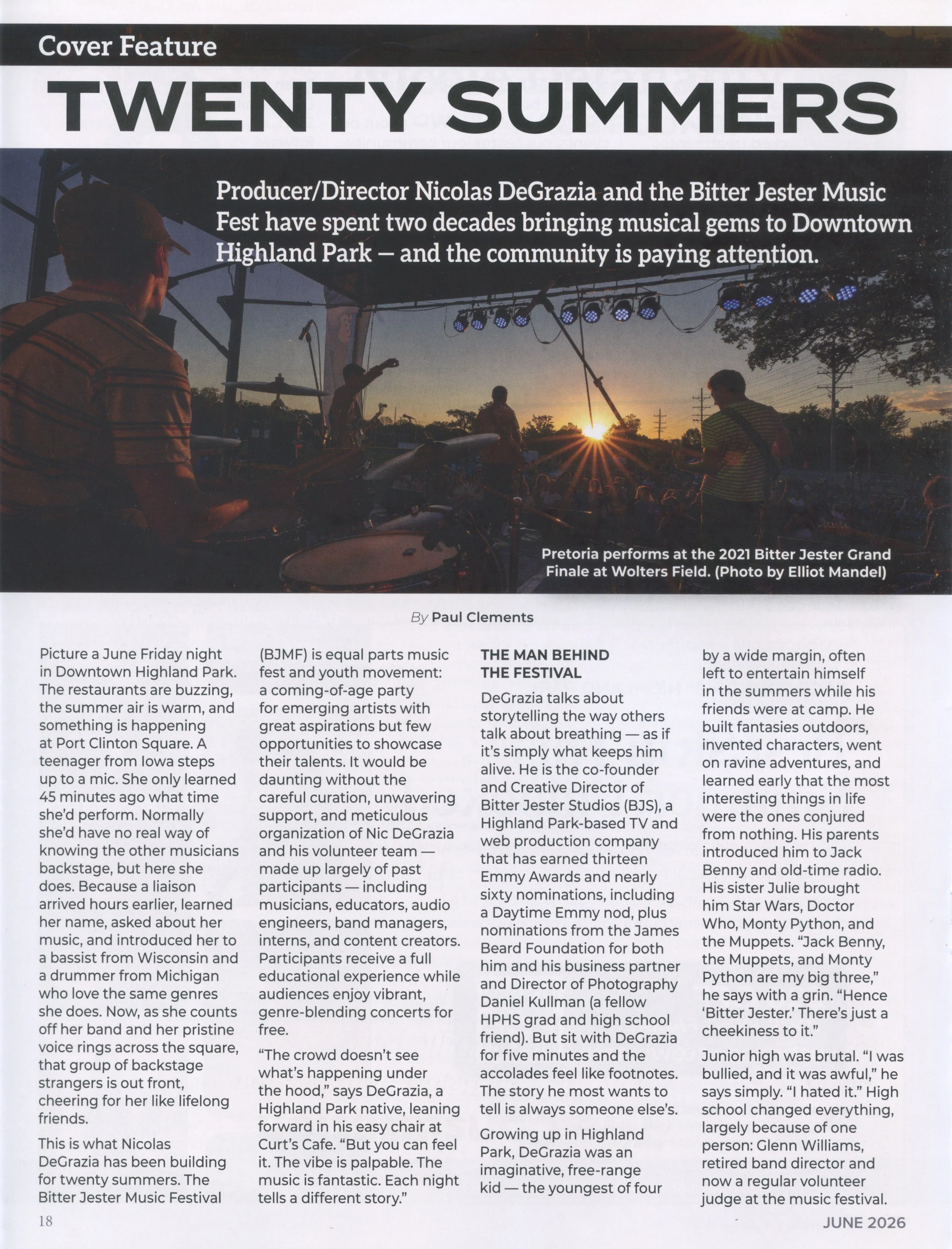
Producer/Director Nicolas DeGrazia and the Bitter Jester Music Fest have spent two decades bringing musical gems to Downtown Highland Park — and the community is paying attention.
Picture a June Friday night in Downtown Highland Park. The restaurants are buzzing, the summer air is warm, and something is happening at Port Clinton Square. A teenager from Iowa steps up to a mic. She only learned 45 minutes ago what time she’d perform. Normally she’d have no real way of knowing the other musicians backstage, but here she does. Because a liaison arrived hours earlier, learned her name, asked about her music, and introduced her to a bassist from Wisconsin and a drummer from Michigan who love the same genres she does. Now, as she counts off her band and her pristine voice rings across the square, that group of backstage strangers is out front, cheering for her like lifelong friends.
This is what Nicolas DeGrazia has been building for twenty summers. The Bitter Jester Music Festival (BJMF) is equal parts music fest and youth movement: a coming-of-age party for emerging artists with great aspirations but few opportunities to showcase their talents. It would be daunting without the careful curation, unwavering support, and meticulous organization of Nic DeGrazia and his volunteer team — made up largely of past participants — including musicians, educators, audio engineers, band managers, interns, and content creators. Participants receive a full educational experience while audiences enjoy vibrant, genre-blending concerts for free.
“The crowd doesn’t see what’s happening under the hood,” says DeGrazia, a Highland Park native, leaning forward in his easy chair at Curt’s Cafe. “But you can feel it. The vibe is palpable. The music is fantastic. Each night tells a different story.”
THE MAN BEHIND THE FESTIVAL
DeGrazia talks about storytelling the way others talk about breathing — as if it’s simply what keeps him alive. He is the co-founder and Creative Director of Bitter Jester Studios (BJS), a Highland Park-based TV and web production company that has earned thirteen Emmy Awards and nearly sixty nominations, including a Daytime Emmy nod, plus nominations from the James Beard Foundation for both him and his business partner and Director of Photography Daniel Kullman (a fellow HPHS grad and high school friend). But sit with DeGrazia for five minutes and the accolades feel like footnotes. The story he most wants to tell is always someone else’s.
Growing up in Highland Park, DeGrazia was an imaginative, free-range kid — the youngest of four by a wide margin, often left to entertain himself in the summers while his friends were at camp. He built fantasies outdoors, invented characters, went on ravine adventures, and learned early that the most interesting things in life were the ones conjured from nothing. His parents introduced him to Jack Benny and old-time radio. His sister Julie brought him Star Wars, Doctor Who, Monty Python, and the Muppets. “Jack Benny, the Muppets, and Monty Python are my big three,” he says with a grin. “Hence ‘Bitter Jester.’ There’s just a cheekiness to it.”
Junior high was brutal. “I was bullied, and it was awful,” he says simply. “I hated it.” High school changed everything, largely because of one person: Glenn Williams, retired band director and now a regular volunteer judge at the music festival.
“I always tell people — there are bad teachers, there are teachers, there are good teachers, there are great teachers, there are exceptional teachers, and then there’s Glenn Williams,” DeGrazia says. “He made you feel safe and welcome. He could reprimand you without cutting you to ribbons and encourage you so subtly you left feeling empowered and seen.”
Band became his home. He played First Trombone throughout high school and at the University of Miami, where he marched in the Band of the Hour and performed at the Orange Bowl. But something was missing.
“I just felt so creatively lost,” he says. “Band wasn’t the same. There wasn’t the same camaraderie.”
When homework got difficult, he would call the HP Public Library from Miami — more helpful, he insists, than his university library — and it kept him tethered to home.
After graduation, he and Kullman returned to the North Shore determined to build a production company centered on film and television but with theatre and music as a major focus. But first they needed to survive. For over two years, they delivered newspapers — including Sunday editions of the Chicago Tribune thick as a phonebook — to downtown skyscrapers. DeGrazia’s route was Wacker Drive. They worked from 11 pm until 6 am, slept briefly, then poured themselves into BJS. By 2004, they had enough clients to quit delivering papers; they never looked back.
“We’ve been starving artists ever since,” DeGrazia says, in a tone that makes clear it is a success story.
The music festival is not his paying job. Though it requires thousands of hours of work each year, DeGrazia takes no salary from the Bitter Jester Foundation for the Arts (the nonprofit behind the festival). But he still shows up for free because he can’t imagine not showing up. The festival is his baby.
THE COMEDY FESTIVAL THAT WASN’T
In the mid-2000s, Highland Park launched a short-lived program called Late Nite HP — an initiative by then-city council member Terri Olian to activate a sleepy downtown by keeping shops and restaurants open until 11 pm. DeGrazia volunteered to help bring entertainment. He arrived at City Hall with an idea he genuinely loved: a comedy competition featuring stand-up and sketch performances inside Late Nite businesses.
He pitched it to then-city manager David Limardi, who listened before saying ten words that changed everything: “Why don’t you do a battle of the bands instead?”
“In my mind I’m thinking, battle of the bands — I don’t want to do a battle of the bands,” DeGrazia recalls. “But out loud I was like, ‘Okay.’”
The Bitter Jester Music Festival was born — though it didn’t have that name yet. It launched as the Late Nite HP Rumble, evolved into the Bitter Jester Battle of the Bands, and grew into what it is today.
The name “Bitter Jester” comes from a sketch comedy character created in 1999 by DeGrazia’s former comedy troupe, Super-Natty. Charles Turck (BJS co-founder and HPHS alumnus) would come out on the Apple Tree Theater stage in a painfully tight jester costume — visibly miserable and furious — holding a sign demanding the audience laugh. When they did, he’d hurl the sign to the ground, flip them off, and storm away.
DeGrazia, a huge fan of irony, loved the character immediately. When it came time to name the company, “Bitter Jester” survived every round of cuts from a list of 200 possibilities. “Is it professional?” he remembers asking Kullman and Turck. “But we all agreed: if someone doesn’t want to work with us because of the name ‘Bitter Jester,’ they’re probably not people we want as clients anyway.”
By 2006 the production company was well underway (though DeGrazia and Kullman wouldn’t win their first Emmys for another six years) and the directive from Limardi and the City launched a new chapter. Year One of the festival was hyper-local: bands from HPHS, a few from Deerfield and Lake Forest — fifteen submissions total. DeGrazia relied on an HPHS student to help connect with young musicians, and the festival slowly gained momentum. When that student graduated, submissions dropped to five. DeGrazia had to beg a previous band to return just to have a competition.
“I remember feeling very alone and that I didn’t want to do it anymore,” he says before pausing. “I thought: ‘either I quit, or I do this right.’” He grins. “But I don’t like quitting. Everything since then has been me trying to do it right.”
WHAT HAPPENS UNDER THE HOOD
This year, the nonprofit music fest received 145 applications from 28 states and two Canadian provinces. The acceptance rate is 16.5%. By the Grand Finale, musical acts are among the top 5% of applicants. Each round of the multi-day competition has a rigorous vetting process by teams of judges, all volunteers, many of them festival alumni. The festival turned away more bands this year than the total number of 2025 applicants. The growth seems exponential.
And every night is free.
Each BJMF concert is a charity event. No admission charge. No parking fee. Family-friendly. Open to anyone wandering past Port Clinton on a June evening hearing something that makes them stop to listen… and hopefully donate, buy a record or t-shirt, or some band merch.
But audiences only see the surface. What happens beneath is where the festival earns its reputation.
About a decade ago, DeGrazia created the “Band Liaison” position — filled by festival alumni a few years older than the current performers. They know the ropes but their real job is quietly engineering human connection. They check in performers, learn where everyone is from, what music they’re into, and what makes them tick. Then they start conversations.
“They’re the catalysts,” DeGrazia says. “Their job is to help you make friends with the other performers. Then they fade into the background and do it again. By night’s end, you’ve got this mosh pit of young musicians from all over the country. They didn’t know each other hours earlier, but now they’re jamming out, following each other on social media, and planning out-of-state tours together.”
Performers all have the same call time and don’t learn when they’ll play until 45 minutes before the concerts begin — by design. Though a literal battle, BJMF cultivates an “all for one” atmosphere, keeping everyone present all evening and turning a competition into something closer to a shared experience. Every 30 minutes, a new band takes the stage — from solo acoustic to rock to jazz to metal and everything in between.
“It’s an appetizer platter,” says DeGrazia. “If something’s not to your taste — go get a beer and come back in twenty minutes to hear me say — in the words of John Cleese — ‘And now for something completely different.’”
He shares a philosophy that says everything you need to know about what the festival stands for.
“Whether you’re playing for 33,000 people or for three people, play the same show,” he says. “Because you never know how you’re impacting people’s lives with your music. And you never know who those three people are! In Highland Park, the quiet guy with the baseball cap pulled down, leaning against a tree? That could be the lead singer of the Smashing Pumpkins.” He lets that sentence land. “And it happens.”
Pumpkins frontman Billy Corgan has judged the festival’s songwriting competition.
These days the festival also runs a robust high school internship program, produces an annual “Live at Bitter Jester” vinyl album from scratch (mixed and mastered by young audio engineers), and bridges the gap between emerging performers and seasoned industry mentors in ways few festivals do.
TWENTY YEARS OF MOMENTS
One of DeGrazia’s favorite stories is from 2012. A ska band called “The Ska-lers” came to BJMF, lost their preliminary night, went home, and wrote a song about losing. They practiced for a year, returned in 2013, performed their original song about losing, and won their Preliminary Round.
“Virtually that entire band is now the core of my volunteer staff,” he says. “I love stories like that.”
Last year’s Grand Champions, “Platinum Moon,” arrived with over a quarter million Instagram followers and almost 650k on TikTok. But they came to Highland Park for the value the festival provides. During a changeover at the Finale, the drummer and singer leaned over to DeGrazia.
“We’ve done a lot of battles,” they told him. “But this is the best feedback, the best experience, the most valuable information we’ve ever gotten from judges. Ever.”
They went on a 22-state tour using the prize money and gear they won at BJMF as an assist. Winners from different seasons have done 18-city tours together. Musicians have stood up in each other’s weddings. New bands have formed out of BJMF bonds. One winning band found their manager here. Finalists go on to play SNL or Seth Meyers or open for national headliners at Ravinia or elsewhere (on Aug. 22, BJMF Runners-Up “Charlieboy” will open for Bonnie Raitt — a prize won at BJMF).
The festival survived COVID — pivoting to a virtual format and using the pause to acquire a mobile stage, now rented out under its nonprofit umbrella for community events. Traveling musicians often stay an extra night, eating and spending money at local businesses, attending each other’s shows as fans.
More recently, Co-Emcee of the Grand Finale, NPR’s Peter Sagal — host of “Wait Wait… Don’t Tell Me!” and an HP resident — has become one of the festival’s most vocal advocates, volunteering for three years running and donating money to the cause.
Sagal has said he knows of no other event like BJMF anywhere in the country and is proud to interview these emerging artists before they get famous.
“It’s an amazing thing that happens right here in Highland Park,” says Sagal. “I encourage you to catch these artists at the very beginning. So that later… when they're filling arenas, you can be incredibly smug about it.”
“I’ll spend $280 on tickets to watch Peter Sagal interview celebrities downtown,” DeGrazia notes with a smile. “And now he’s interviewing our artists in front of our Finale crowds and the tickets are free! As a lifelong NPR and ‘Wait Wait’ fan, it’s kind of incredible.”
Building this festival has been hard work but none of it pays DeGrazia a salary. He is clear about that.
“So many people helped me when I was starting out,” he says. “As my band director, Glenn gave me something beyond the curriculum. He instilled in me the love of music and the idea that band was a family. And he nurtured the desire in me to give that to others.”
It’s the whole idea of karma. “I want to help young people who need help, and I trust that if and when I need help, people will be there for me. Particularly when I’m a very old starving artist,” he says with a laugh.
THE NEXT TWENTY
The 20th Annual Bitter Jester Music Festival runs this June at Port Clinton Square, building toward the Grand Finale on June 27. Full dates and details are in the sidebar below.
DeGrazia sees the 20th anniversary not as a finish line but as a threshold. Many of his core team — mostly alumni who grew up through the festival — are now in their 30s, building careers and starting families. They cannot volunteer indefinitely. The mission is ready, he believes, for the kind of generous donor investments and corporate sponsorships that will sustain BJMF for another twenty years.
“This is like my child graduating college,” he says. “We’re about to embark on the real journey. We’ve hammered out the kinks and now we need strengthening.”
Twenty years in, BJMF is at an inflection point. It won the 2024 Highland Park Arts Award and, more recently, “Best Small Festival” in a fan-driven vote by “Festy Go Nuts.” But it has outgrown what one sleep-deprived leader and devoted volunteers can sustain alone.
The bands keep coming — record-breaking application numbers every year — and the infrastructure that receives the musicians, mentors them, and sends them back into the world needs to grow with them. That takes community. It takes the kind of civic pride that says we built something rare here, we’re proud of it, and we will not let it fade.
Because what Highland Park has in BJMF is genuinely rare. Peter Sagal is right: there is no other festival quite like it — not one with this level of Emmy-worthy production, this depth of mentorship and feedback, this quality of emerging talent, and this commitment to keeping its concerts free. DeGrazia has spent over two decades giving everything he has to young musicians who needed someone to believe in them. The question now is simple: who is going to do that for him and his team?
The 2026 season begins June 5 at Port Clinton, 600 Central Ave. Come hear something you’ve never heard before. Bring your kids, your friends, your neighbors. And if the music moves you in that moment — if you find yourself staying for one more band, and then another — consider what it means to get behind the people making that moment possible.
Some things are worth showing up for. Some things are worth investing in. The Bitter Jester Music Festival happens to be both.
BITTER JESTER MUSIC FESTIVAL: 2026 AT A GLANCE
When: June 5, 6, 12, 13 (Prelims) & June 27 (Grand Finale)
Where: Port Clinton Square (Prelims) & Second St (Grand Finale), Downtown Highland Park, IL
Cost: Free — no admission charge, no parking fees
Who: Emerging musicians, generally 21 and under, from across the U.S. and Canada
Submissions: 145 applications from 28 states + two provinces in 2026 (up 57% from 2025)
Also: Satellite concerts at Chicago Botanic Garden (June 8, 15); “Best Of” Showcase at Navy Pier (Labor Day, Sept. 7); Charlieboy opens for Bonnie Raitt at Ravinia (Aug. 22)
Emcees: Nicolas DeGrazia & Peter Sagal, host of NPR’s “Wait Wait… Don’t Tell Me!”
More info or to Donate: BitterJesterMusic.org — discover your next favorite band!
Photo Credits:
1) Cover: Photo by Daniel Kullman, Bitter Jester Studios.
2) Page 18: Pretoria performs at the 2021 Bitter Jester Grand Finale at Wolters Field. (Photo by Elliot Mandel)
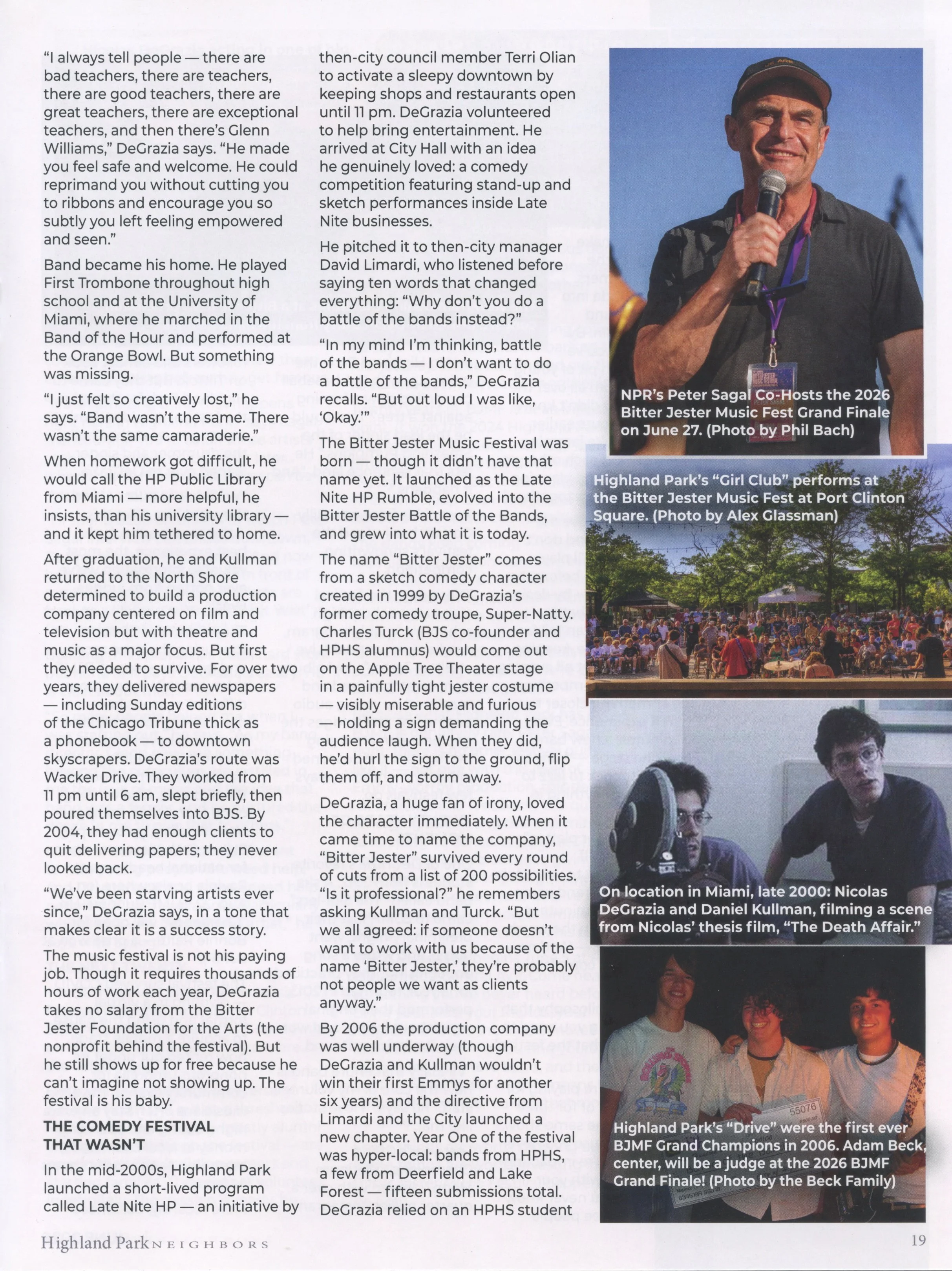
3) Page 19: NPR's Peter Sagal Co-Hosts the 2026 Bitter Jester Music Fest Grand Finale on June 27. (Photo by Phil Bach)
4) Page 19: Highland Park's "Girl Club" performs at the Bitter Jester Music Fest at Port Clinton Square. (Photo by Alex Glassman)
5) Page 19: On location in Miami, late 2000: Nicolas DeGrazia and Daniel Kullman, filming a scene from Nicolas' thesis film, "The Death Affair."
6) Page 19: Highland Park's "Drive" were the first ever BJMF Grand Champions in 2006. Adam Beck, center, will be a judge at the 2026 BJMF Grand Finale! (Photo by the Beck Family)
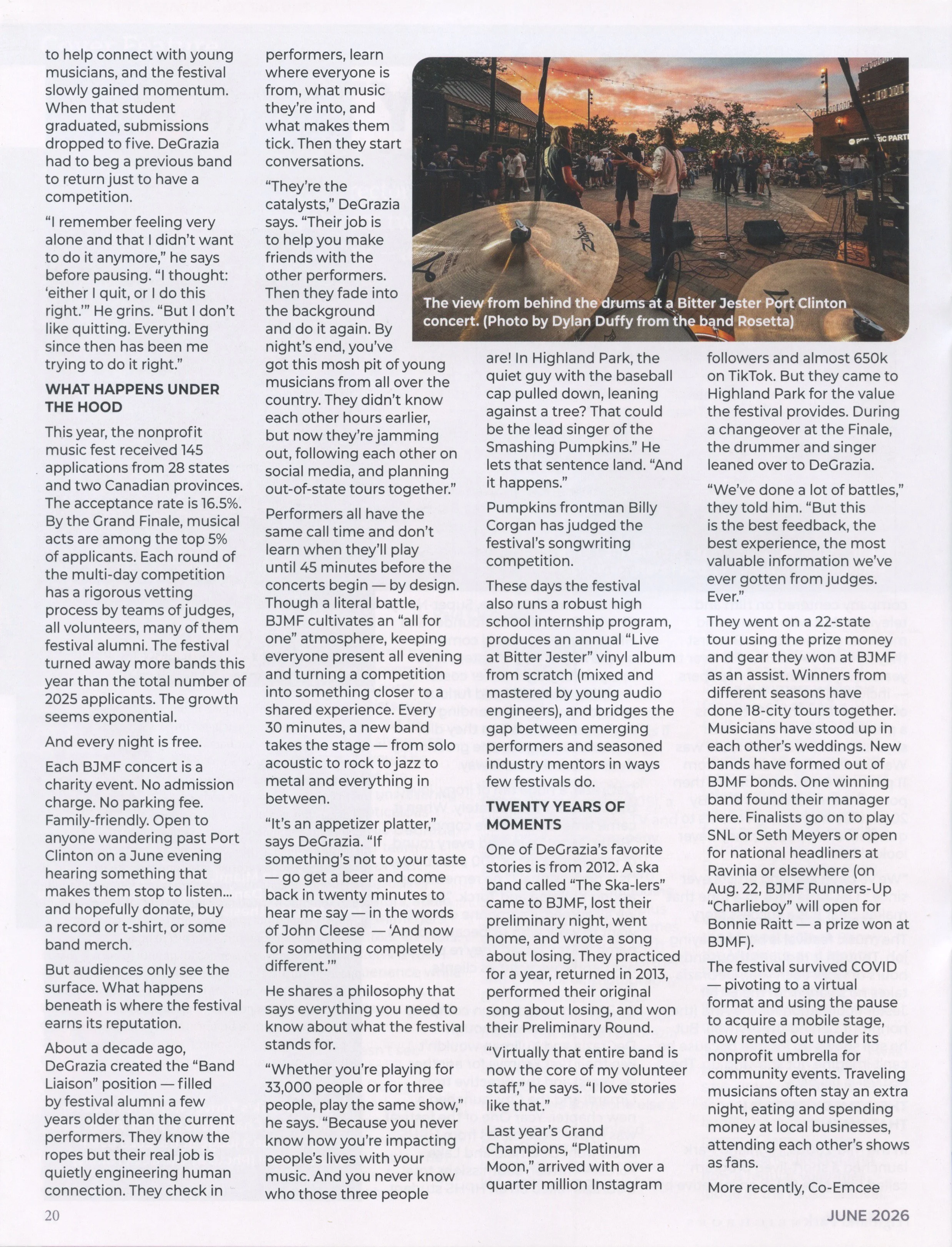
7) Page 20: The view from behind the drums at a Bitter Jester Port Clinton concert. (Photo by Dylan Duffy from the band Rosetta)
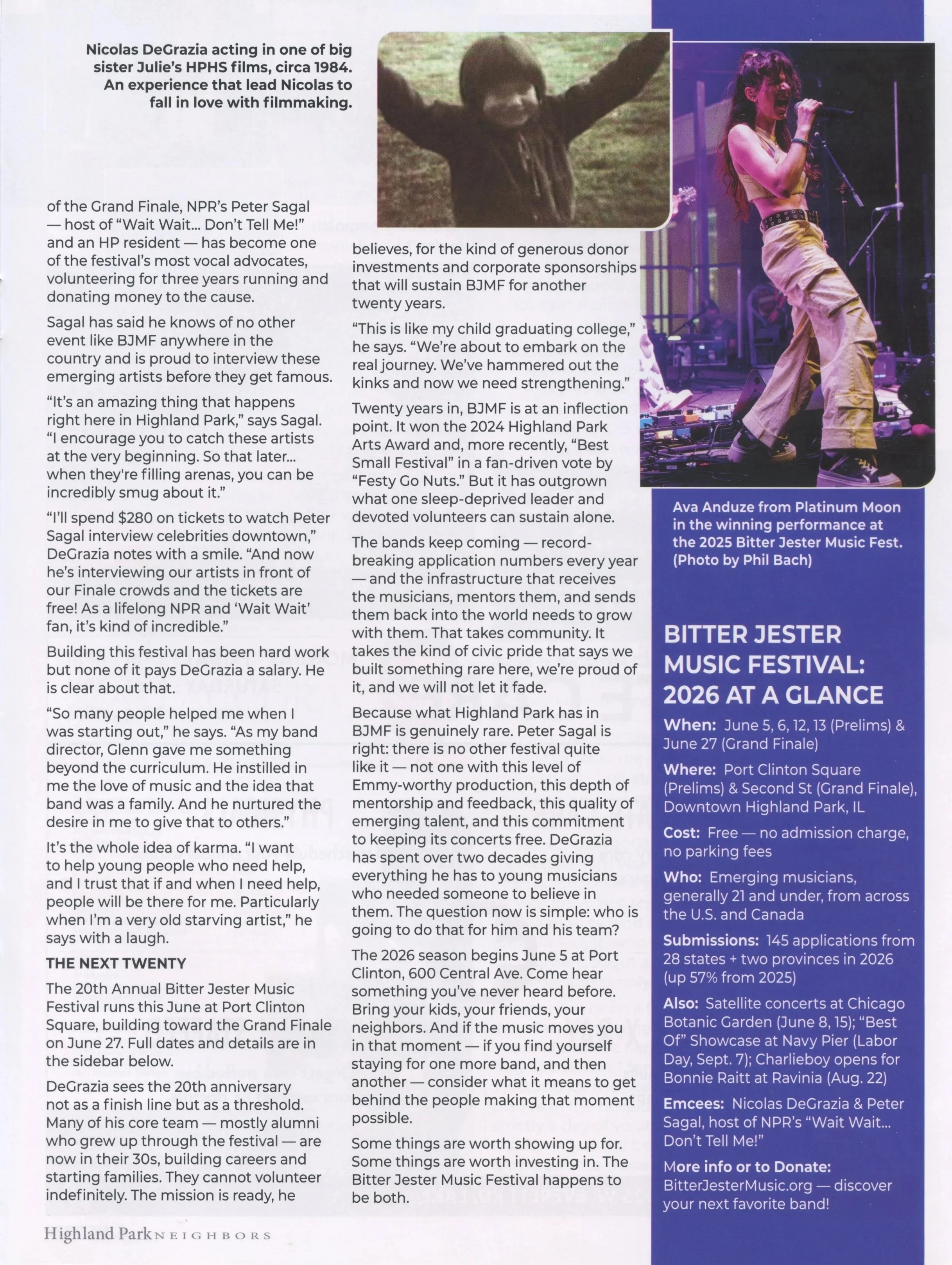
8) Page 21: Nicolas DeGrazia acting in one of big sister Julie's HPHS films, circa 1984. An experience that lead Nicolas to fall in love with filmmaking.
9) Page 21: Ava Anduze from Platinum Moon in the winning performance at the 2025 Bitter Jester Music Fest. (Photo by Phil Bach)
Magazine Publisher:
Highland Park Neighbors Magazine is published by Mike Stark, Peter Hansen, and Best Version Media (founded in 2007).